Mobile RV Furnace Repair in Central Texas
An RV furnace that fails to ignite, cycles without producing heat, or runs the blower without heat output is one of the more urgent house-system problems in Central Texas fall and winter conditions. Boss Bull provides mobile RV furnace repair across Central Texas, coming to your location to service the affected system on site.
Every repair, no questions asked.
Better Business Bureau accredited.
$500–$25,000. 0–35.9% APR based on creditworthiness.
Austin and Central Texas.
Overview
RV LP furnaces operate on a timed ignition sequence: the thermostat calls for heat, the blower starts, the burner lights, and the heat exchanger warms the air before it reaches the living space. A failure at any point in that sequence stops heat delivery. Blower-runs-but-won't-ignite is the most common complaint — it typically points to the sail switch, ignitor, or gas valve, depending on the point in the ignition cycle where the sequence fails.
Central Texas RV owners use furnaces primarily during fall and winter cold snaps and overnight camping. RV furnaces that sit unused for months — particularly those stored with debris near the exhaust vent — are prone to ignition failures, nest obstructions, and burner fouling when they are first needed again each season. Pre-season furnace service is the most reliable way to ensure the furnace is ready before the first cold night.
We service Dometic, Atwood, and Suburban LP furnaces. Common repairs include sail switch replacement, ignitor service, gas valve testing, blower motor replacement, burner cleaning, and exhaust vent obstruction removal. When parts are on the van, most furnace repairs are completed on the first visit.
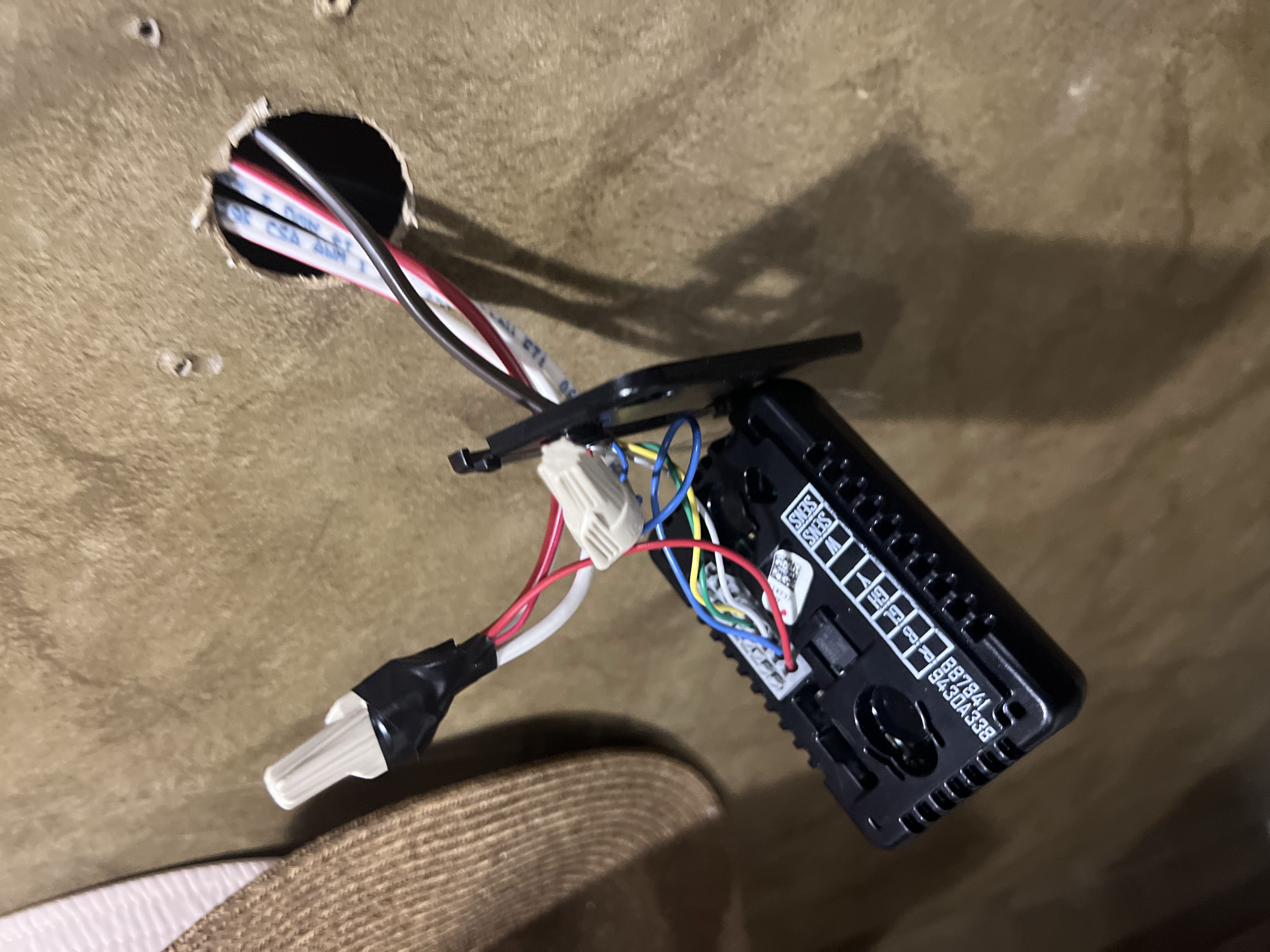
Thermostat control module pulled from the wall mount to access the wiring harness during a furnace service call. Low-voltage wiring connections are documented before any components are disconnected.
The control was removed from the wall mount to inspect the wiring and confirm the thermostat was not the source of the furnace ignition fault. Wire color, connector condition, and routing were documented before the replacement module was installed.
Common Problems We Fix
- Furnace blower runs but no heat is produced
- Furnace attempts to light but cycles off without igniting
- No response from the furnace when thermostat calls for heat
- Furnace lights but shuts off prematurely during the heating cycle
- Unusual noises — squealing, rattling, or grinding — during furnace operation
- Furnace has not been used in several months and does not respond correctly
- Exhaust vent blocked or airflow-restricted
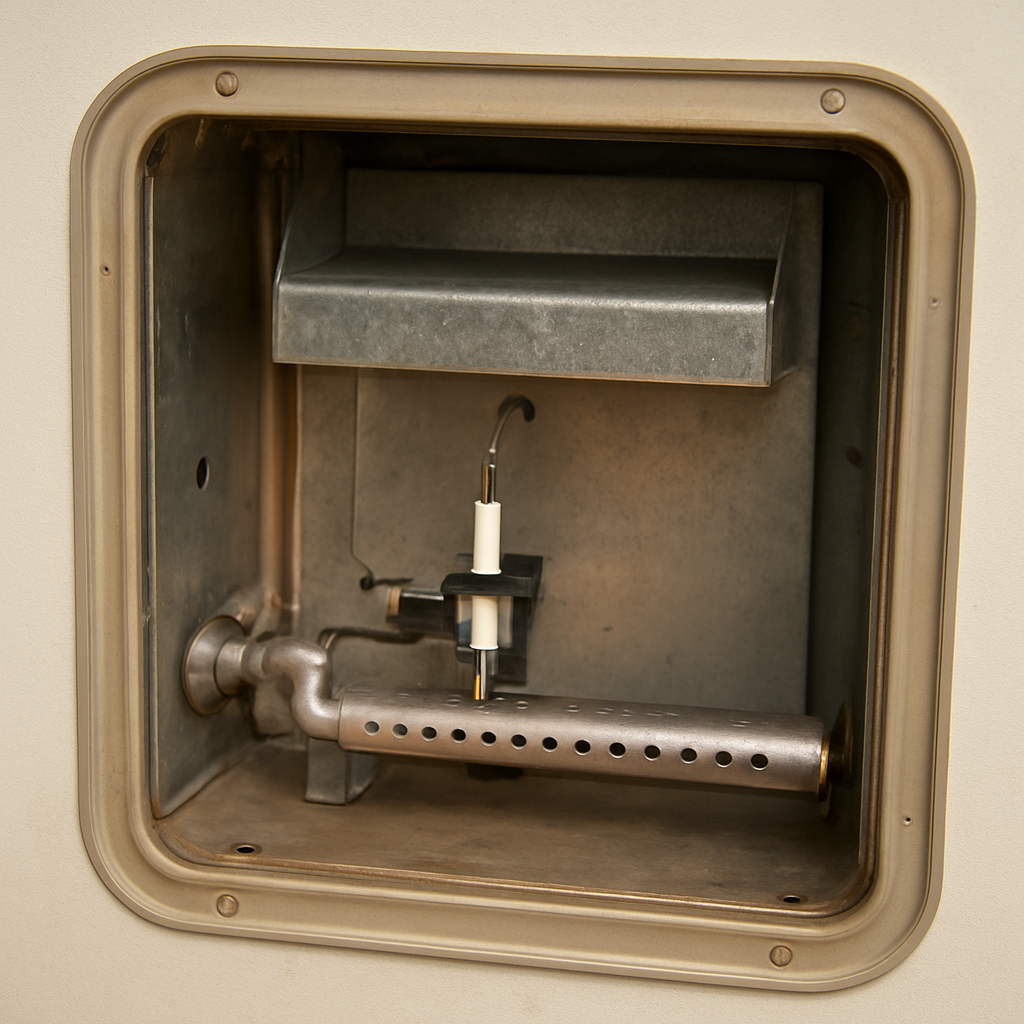
Furnace interior documented during a pre-season service call. The burner tube, ignitor electrode, and burner assembly are inspected for fouling, debris, and ignitor wear before the unit is tested.
The access panel is removed before every furnace service call to inspect the burner, sail switch, and ignitor condition. An ignitor that is visibly worn or positioned incorrectly is replaced before attempting an ignition cycle test.
Common Findings During RV Furnace Repair Service Calls
Furnace service calls most often involve the ignition sequence — the blower, sail switch, ignitor, and gas valve components that must operate in sequence for heat to be produced. The following conditions appear most frequently.
- Sail switch failure — stops the ignition sequence after the blower starts; the most common cause of the blower-runs-no-heat complaint
- Exhaust vent obstruction — insect nests or debris blocking the exterior vent, preventing the pressure differential required for ignition
- Burner fouling — carbon and debris buildup at the orifice restricting LP flow for consistent combustion
- Ignitor wear — weak spark insufficient to reliably light the burner
- Gas valve faults — solenoid or valve body failures interrupting LP delivery after the ignitor fires
- Low 12V battery voltage contributing to intermittent ignition failure at the control board or ignitor
- Air filter fouling — restricted airflow reducing blower performance and heat delivery
- Duct obstruction or disconnection — heat not reaching the living area even when the furnace fires correctly
Technician Observations
What Owners Commonly Report
Presenting complaints we hear most often on these service calls.
- Blower runs but the furnace never produces heat
- Furnace cycles on and off rapidly without completing a heating cycle
- Thermostat calls for heat but nothing happens
- Furnace worked last winter and now does not respond
- Furnace runs for a few minutes then shuts off
What We Frequently Find
Actual conditions we document when we arrive on site.
- Sail switch failure — the sail switch confirms that the blower is moving enough air before allowing ignition; a failed sail switch stops the ignition sequence after the blower starts, which is the most common cause of the blower-runs-no-heat complaint
- Exhaust vent obstruction — nests from insects or small animals in the exterior vent interrupt the pressure differential required for the ignition sequence; common on RVs stored outdoors between seasons
- Burner fouling — carbon buildup and debris accumulation on the burner orifice and heat exchanger inlet restrict the LP flow needed for a consistent flame
- Ignitor wear — LP furnace ignitors have a service life measured in ignition cycles; worn ignitors produce a weak spark that cannot reliably light the burner under normal LP pressures
- Gas valve concerns — LP gas valves can stick, fail to open fully, or develop solenoid faults that interrupt LP delivery to the burner after the ignitor has fired
- Low battery voltage at the furnace circuit — LP furnaces require adequate 12V power for the control board and ignitor; a battery bank below 12.0V during ignition attempts is enough to cause intermittent or total ignition failure without any mechanical fault in the furnace itself
Service Recommendations
What we typically advise based on our findings.
- Pre-season furnace service before the first cold stretch of fall is the most reliable way to confirm ignition, blower, and burner function before the furnace is needed at night
- RVs stored outdoors between uses should have the furnace exhaust vent checked for nest material before the furnace is operated each season
- Battery bank condition affects furnace ignition directly — low battery voltage is a frequent contributing factor in furnace ignition failures that appear to be mechanical
- Do not attempt to force-ignite a furnace that is cycling without lighting — repeated failed ignition cycles can flood the heat exchanger with unburned LP that needs to dissipate before the next attempt
Why RV Owners Choose Mobile RV Service
- Heat is restored at your location — furnace service completed on site before a cold Central Texas night becomes a problem
- Sail switches, ignitors, and common burner components stocked on the service van for same-visit repair
- Service at RV parks, campgrounds, storage facilities, and residences across Central Texas
- Pre-season furnace service scheduled before fall cold snaps arrive in Central Texas
- Service across Central Texas including Austin, Georgetown, Round Rock, Cedar Park, Kyle, Buda, and surrounding areas
- Financing available through Wisetack for larger furnace or HVAC system repairs
Furnace Brands We Commonly Service
- Dometic (formerly Atwood): AFMD, AFSD, and AFMDI series LP furnaces
- Atwood: legacy AFMD and AFSD series LP furnaces
- Suburban: SF-series and NT-series LP forced-air furnaces
- Dometic thermostat and control module replacement
- Suburban ignitor and sail switch service
- Furnace exhaust vent obstruction removal
- LP supply line and regulator pressure verification as part of furnace diagnostics
- 12V furnace circuit and fuse condition review
Related Services
Brands We Service
Service Areas
Frequently Asked Questions
What Our Customers Say
“Our camper AC went out and we called Rich on a Saturday, thinking no way we were going to get someone out on the weekend. But Rich came out that afternoon, took a look at the unit and came up with a solution.”
“He went into great detail telling me what was wrong (even showed me) and what would need to be done. He is very responsive, respectful and efficient!”
“Prices are fair. They communicate well. They show up on time. They do what they say they will do. I will never use someone else.”
Ready to get your RV back in service?
Schedule mobile RV repair across Central Texas, or call and talk to a tech now.