
Mobile RV Solar Installation in Central Texas
Every day your generator runs at a campsite, you are paying fuel costs and burning hours off the engine to power things that the sun could provide for free. A properly sized RV solar system changes the equation — charging the house battery bank from the roof while you sleep, while you hike, while the RV sits at a dry camp location that has no hookups in sight. Boss Bull Mobile RV Services installs RV solar systems across Central Texas at your location, working with Victron, Go Power, and compatible lithium battery systems.
Every repair, no questions asked.
Better Business Bureau accredited.
$500–$25,000. 0–35.9% APR based on creditworthiness.
Austin and Central Texas.
Overview
Central Texas is one of the best solar environments in the country. The sun hours are high, the dry camping and dispersed use locations across the Hill Country and West Texas are plentiful, and the cost of running a generator through a Texas summer is not trivial. Owners who upgrade to solar consistently report that they were running their generators far more than they needed to before the installation.
Solar is a system, not a component. Panels produce DC power. A charge controller converts that power into the correct charge profile for the house battery bank. The battery bank stores the energy. If any one of those elements is undersized, mismatched, or misconfigured, the system underperforms — and the most common failure mode is not hardware, it is configuration. Charge controllers not set for the battery chemistry, wiring with too much voltage drop between the panels and the controller, and panel placement that puts part of the array in shade from rooftop obstructions are responsible for the majority of underperforming existing solar installations we service.
The combination of solar panels with a lithium battery bank is where the real off-grid capability comes from. Lithium batteries accept a full charge faster, hold more usable capacity, and work more efficiently with solar charge profiles than lead-acid batteries. An RV with a correctly sized solar array and a lithium bank can power lighting, fans, water pump, small appliances, and electronics indefinitely in good sun — with the generator as a backup, not a requirement.
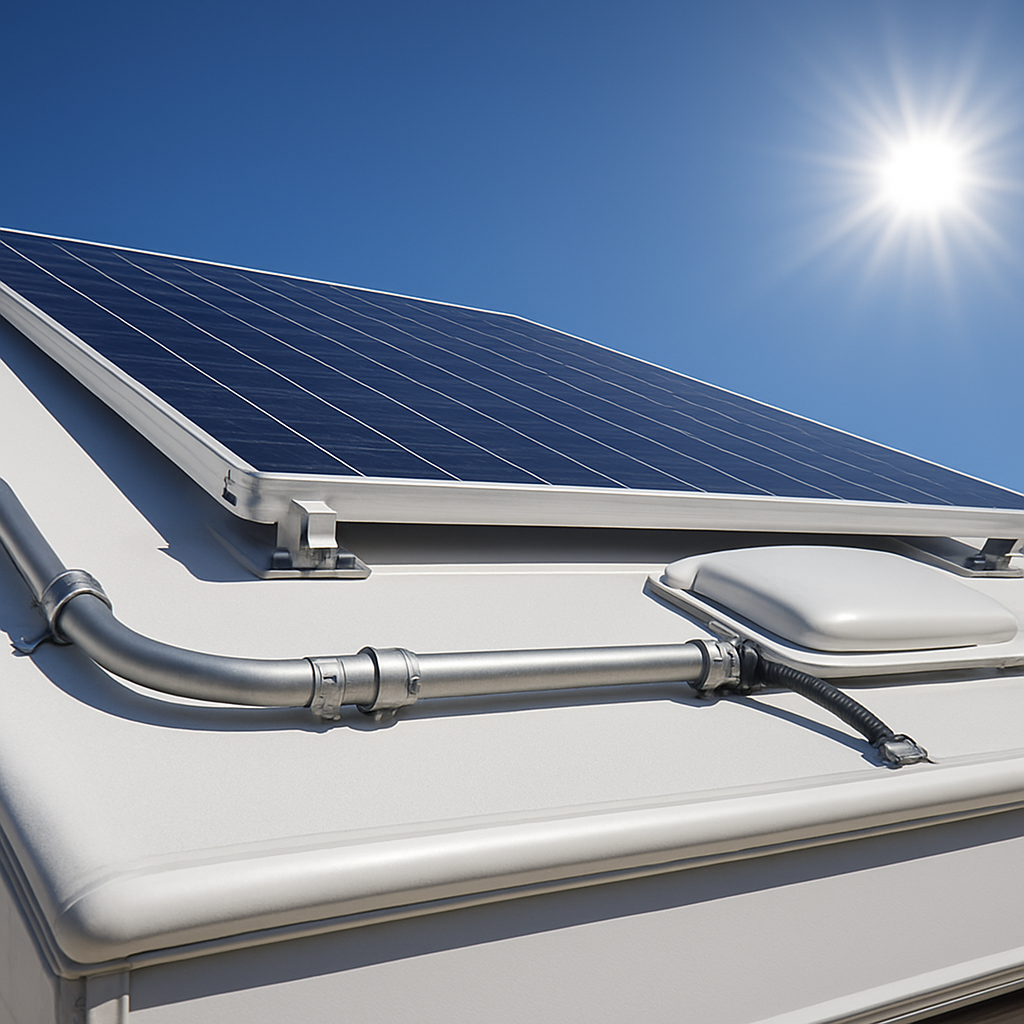
Rooftop solar panel installation on a travel trailer. Panel rail mounting, conduit routing, and penetration sealing are completed before system commissioning.
Rooftop panel placement is determined before any drilling begins. Shading from AC units, vents, and antennas is mapped during site assessment. Conduit is routed to minimize additional penetrations through the roof.
Common Problems We Fix
- Generator runtime is excessive and you want to reduce it
- Shore power is unavailable or unreliable at preferred camping locations
- House batteries are not maintaining charge during use without hookups
- An existing solar system is underperforming or not charging effectively
- Upgrading to lithium batteries and want a compatible solar charge system
- Planning extended off-grid RV use and need a reliable charging solution
Common Findings During RV Solar Installation Service Calls
Both new installations and service calls on existing solar systems involve a consistent set of conditions. The following appear most frequently.
- Undersized wiring between panels and the charge controller creating voltage drop and reduced charging current
- Charge controller configuration mismatch — lead-acid charge profiles applied to AGM or lithium banks
- Panel placement with unaddressed rooftop shading reducing output during peak sun hours
- Fusing and disconnect arrangements that do not meet current wiring practice standards
- Battery bank sizing insufficient for the solar array or the RV electrical load
- Connection failures at panel junction boxes from moisture intrusion or vibration loosening
- Existing go Power or other charge controller units that have failed or are operating outside their configured parameters
Technician Observations
What Owners Commonly Report
Presenting complaints we hear most often on these service calls.
- I want to reduce how much I run the generator at camp
- I dry camp frequently and my batteries are depleted by midday
- I have solar panels but they do not seem to be charging my batteries effectively
- I want to go off-grid for extended periods without shore power
- I am upgrading to lithium batteries and want a solar system that works with them
What We Frequently Find
Actual conditions we document when we arrive on site.
- Existing solar installations with undersized wire runs that create significant voltage drop between the panels and the charge controller, reducing effective charging current
- Charge controllers not properly configured for the battery chemistry — lead-acid charge profiles applied to AGM or lithium batteries reduce battery performance and lifespan
- Panel shading from rooftop obstructions — AC units, vents, and antennae — that significantly reduce output during peak sun hours; panel placement that accounts for shading improves system performance
- Battery banks that are undersized for the solar array, limiting the energy that can be stored even when generation is adequate
- Fusing and disconnect arrangements that do not comply with current wiring practices, creating potential safety concerns in the event of a fault
Service Recommendations
What we typically advise based on our findings.
- System sizing matters — a solar installation that is undersized for the actual electrical load will not meet expectations regardless of how well it is installed; we review the RV's load profile before recommending panel and battery capacity
- Victron charge controllers provide accurate battery monitoring and configurable charge profiles that are particularly important when combining solar with lithium battery banks
- Panel placement on the rooftop should account for shading from existing rooftop components — a partially shaded panel in a series string affects the output of all panels in that string
- Solar installation works best as part of a complete system review — panels, controller, wiring, and battery bank all need to be matched for the system to perform as expected
Why RV Owners Choose Mobile RV Service
- Off-grid range extended at your location — panel installation, charge controller configuration, and system commissioning all completed on site without a shop drop-off
- Rooftop installation completed at your RV park, campground, storage facility, or residence
- Victron charge controller configuration and system commissioning included in the installation visit
- Service across Central Texas including Austin, Round Rock, Georgetown, Cedar Park, Kyle, Buda, and surrounding areas
- Financing available through Wisetack for solar panel and battery system installations
Solar Brands & Systems We Commonly Install
- Victron Energy: SmartSolar charge controllers, MultiPlus inverter-chargers, BMV battery monitors
- Go Power: solar panel kits and charge controllers for standard RV installations
- Battle Born Batteries: LiFePO4 lithium house battery systems
- Expion360: lithium battery systems with integrated battery management
- Rigid monocrystalline solar panels for rooftop installation
- Panel wiring, combiners, and fusing systems
- Shore power and solar integration — transfer switches and inverter-charger coordination
- Battery monitoring and display systems
More From This Service
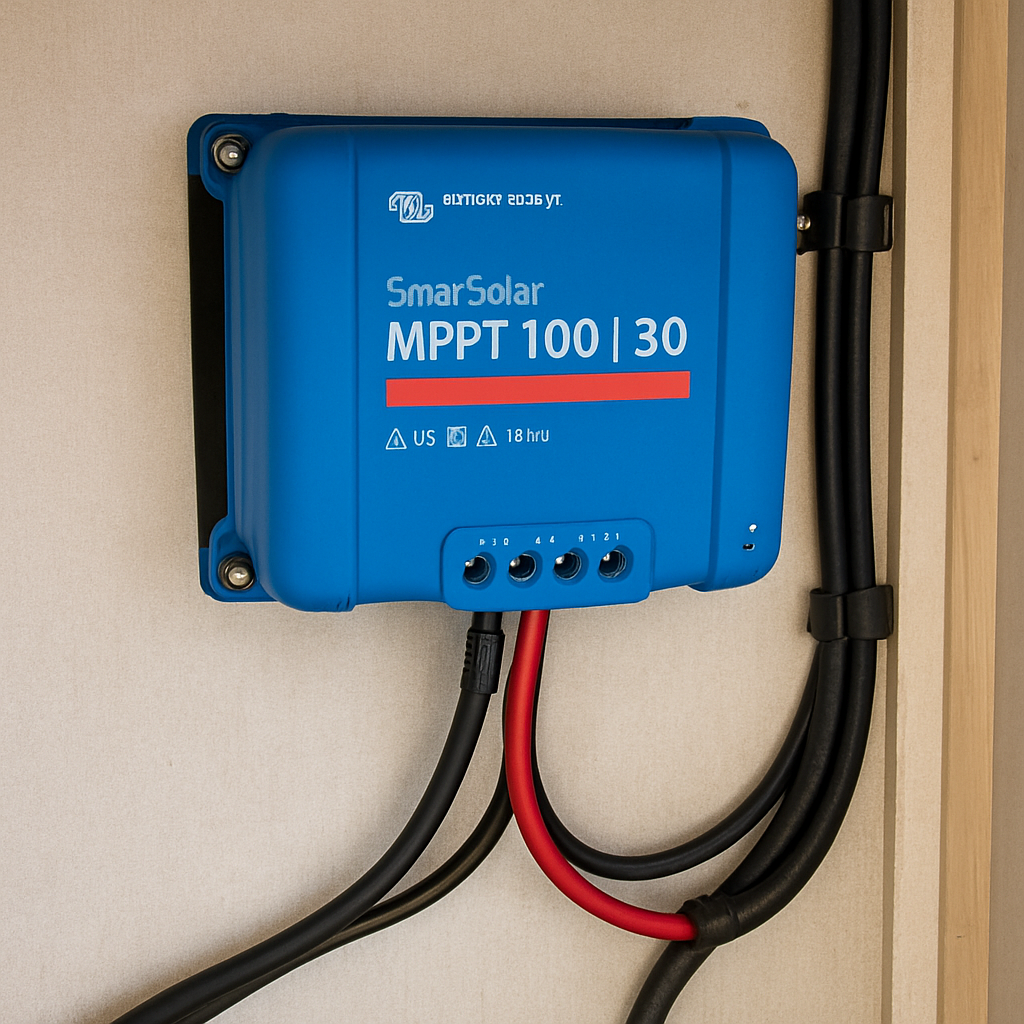
Victron SmartSolar MPPT charge controller installed and wired inside an RV. Cable management and labeling are completed before the system is commissioned.
The charge controller is configured for the specific battery chemistry before commissioning — LiFePO4 profiles are different from lead-acid, and a misconfigured controller will undercharge a lithium bank regardless of available solar generation.
Related Services
Service Areas
Frequently Asked Questions
What Our Customers Say
“Our camper AC went out and we called Rich on a Saturday, thinking no way we were going to get someone out on the weekend. But Rich came out that afternoon, took a look at the unit and came up with a solution.”
“He went into great detail telling me what was wrong (even showed me) and what would need to be done. He is very responsive, respectful and efficient!”
“Prices are fair. They communicate well. They show up on time. They do what they say they will do. I will never use someone else.”
Ready to get your RV back in service?
Schedule mobile RV repair across Central Texas, or call and talk to a tech now.